 Alliance for Catholic Education
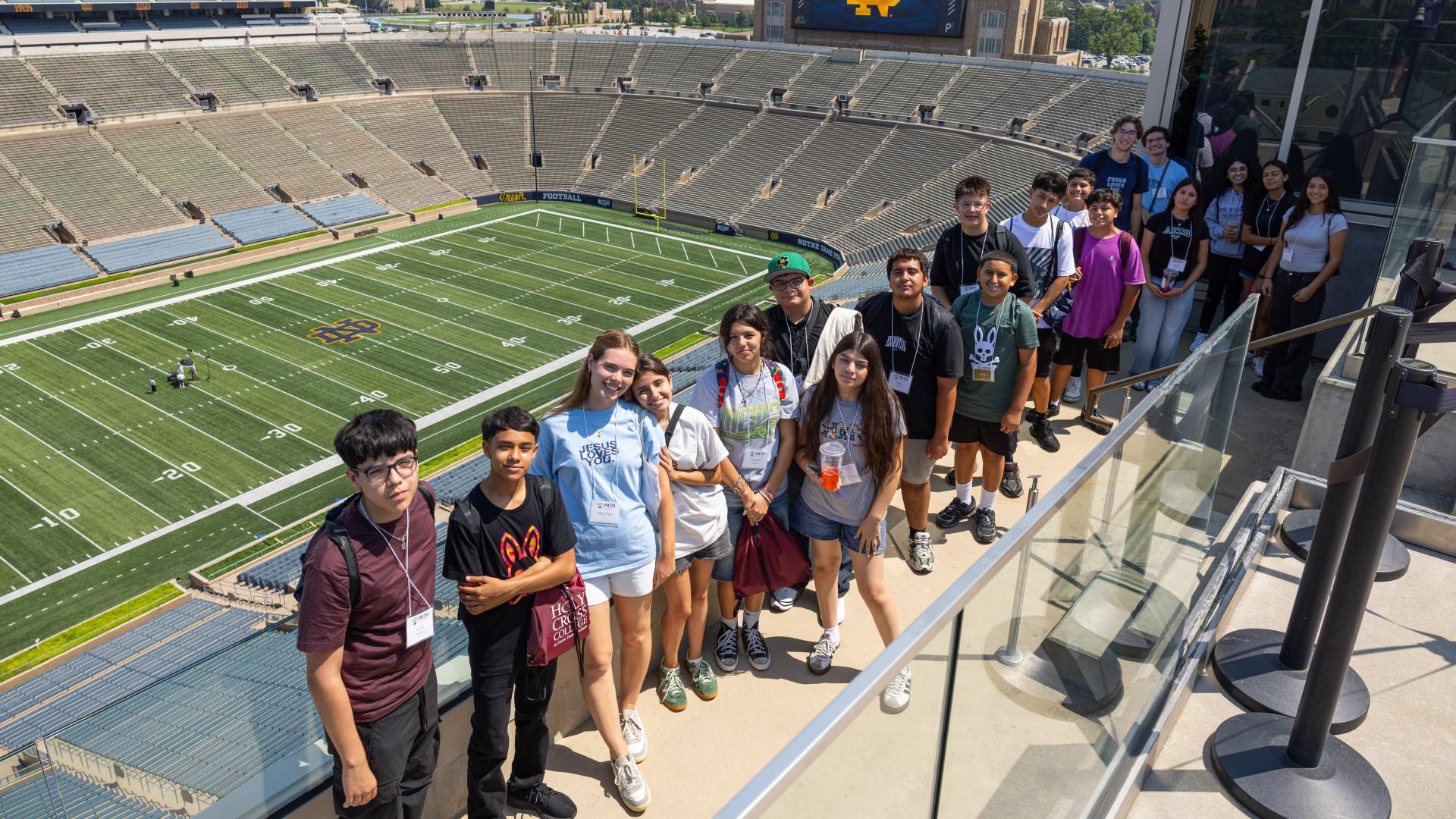
A summer trip to campus for a small group of rising ninth graders from the Southwest supports the University of Notre Dame’s mission to promote college access through a distinct experiential learning opportunity, an extension of a program students participated in throughout middle school.
The Notre Dame campus experience, called the Scholar Immersion Program, serves as an incentive for students who devote three summers to Pursuing Achievement Through Higher Education (PATH), a joint offering of the University’s Alliance for Catholic Education, housed within the Institute for Educational Initiatives (IEI) and in partnership with the Diocese of Tucson. PATH provides program participants, most of whom would be the first generation in their family to graduate from college, with five weeks of dedicated tutoring and skill-building over three middle school summers to improve student outcomes by building pathways to higher education.
Before traveling to South Bend, PATH students have participated in a program visit to the University of Arizona, a campus local to their communities, but the Notre Dame trip is different. Many students will fly for the first time to arrive on campus, where they will stay overnight in a dorm room—another first. As the program transitions from summer intensives with middle schoolers from Tucson’s Santa Cruz and St. John the Evangelist Catholic schools to one-on-one check-ins and FAFSA workshops at their various high schools, the Scholar Immersion Program represents a substantive way to cement community bonds and keep students engaged.
“People often ask us why we do this trip in their rising ninth-grade year. In some ways, an admissions presentation might not seem wildly helpful for them yet,” Alec Torigian, national coordinator for PATH, said. “More than anything, we're trying to give them a taste of what they're about to spend four years working for, so if you really loved some components of tasting college life, maybe—just maybe—you'll remember that when you're a tenth grader, struggling with your math class and deciding how hard you want to work at it.”
The five-day trip extends the exploration of the college experience to the higher-ed classroom and is made possible only with the support of more than 50 people outside the core PATH team. Students are invited to sit in on a session from Notre Dame’s God and the Good Life philosophy course, an engineering seminar, and a writing and rhetoric class. More broadly, the pre-college visit emphasizes holistic development through practical, lived experiences on campus, including Mass at the Grotto and a visit to Fr. Hesburgh’s office, as well as a simulated college resources and activities fair. The Scholar Immersion Program’s unique experiential learning opportunity gives participants a chance to practice being a college student: going to class, practicing their faith, and seeking out support and connection through resources provided by the institution.
But Torigian explained that the pilgrimage to Notre Dame is more than ”college content and context” for PATH participants who otherwise might have limited access to both, or a well-deserved celebration of student achievement to date. The Scholar Immersion Program has proven itself to be an additional, measurable investment in student success.
“To do this crazy thing, where you're like, ‘I traveled across the country on my first plane, stayed overnight, lived in the dorm—it's just like a deeply memorable bonding experience,” Torigian said. “The number of kids who go on this trip and stay involved with us after is not insignificant. It's more than 90 percent.”
For students who commit to PATH Rising Summer, programming begins the summer before their sixth-grade year. Participation means waking up early enough to make a 7:15 a.m. bus ride to the program site for more than a month of community building and supplemental instruction. Successful completion of three PATH summers is required for students to be part of the trip to the University of Notre Dame before beginning their high school careers.
“This group of kids is used to spending their summers with us, and this is the first summer that they're not, so we get them together for a couple of afternoon meetings to prep for this trip,” Torigian said. PATH leadership actively encourages program graduates to spend the remainder of the summer months becoming involved in the high school they will attend in the fall, through sports or bridge tutoring programs.
“It's fun when we get them together for these two prep meetings because they’re so pumped to see each other and compare notes about post-eighth-grade life in their first month of it, especially when they talk about their first experiences at their high school campuses."
“It's fun when we get them together for these two prep meetings because they’re so pumped to see each other and compare notes about post-eighth-grade life in their first month of it, you know.”
Now in its tenth year, PATH has seen 100 percent of its first three program cohorts graduate from high school, with 95 percent of those students going on to attend colleges across the country. Among those PATH alumni is a rising junior enrolled at Notre Dame. Torigian is hopeful that the program will prove itself to be a “long play” for the University and its commitment to welcoming students from a variety of backgrounds as part of the undergraduate community.
"We like to point out that while it's true that our kids would be blessed if given the opportunity to attend Notre Dame, it's also true that Notre Dame would be blessed by having our kids—they have so much to add to the community,” Torigian said.
“With our commitment to kids and families starting at such a young age, this is a potential long-play benefit for Notre Dame's admission,” he added. “And if we were able to expand to more sites across the country, that would mean more good news for kids and for Notre Dame."